01 · Hook
How does your body move?
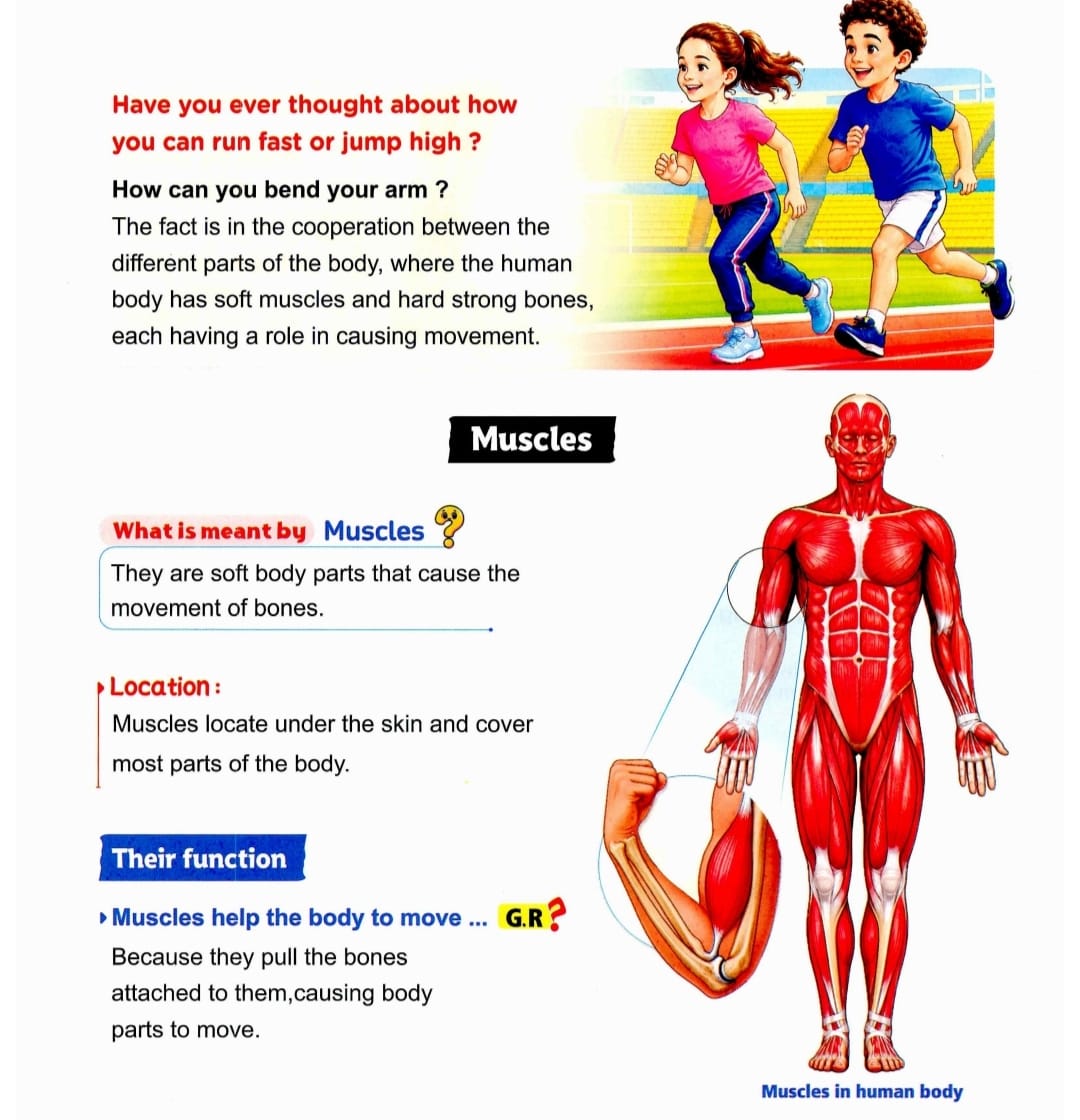
Have you ever thought about how you can run fast or jump high? How can you bend your arm?
The fact is in the cooperation between different parts of the body.
The human body has soft muscles and hard, strong bones — each has a role in causing movement.
Run fast — muscles pull bones.
02 · Meet the skeleton
Bones build your frame
What is meant by bones?
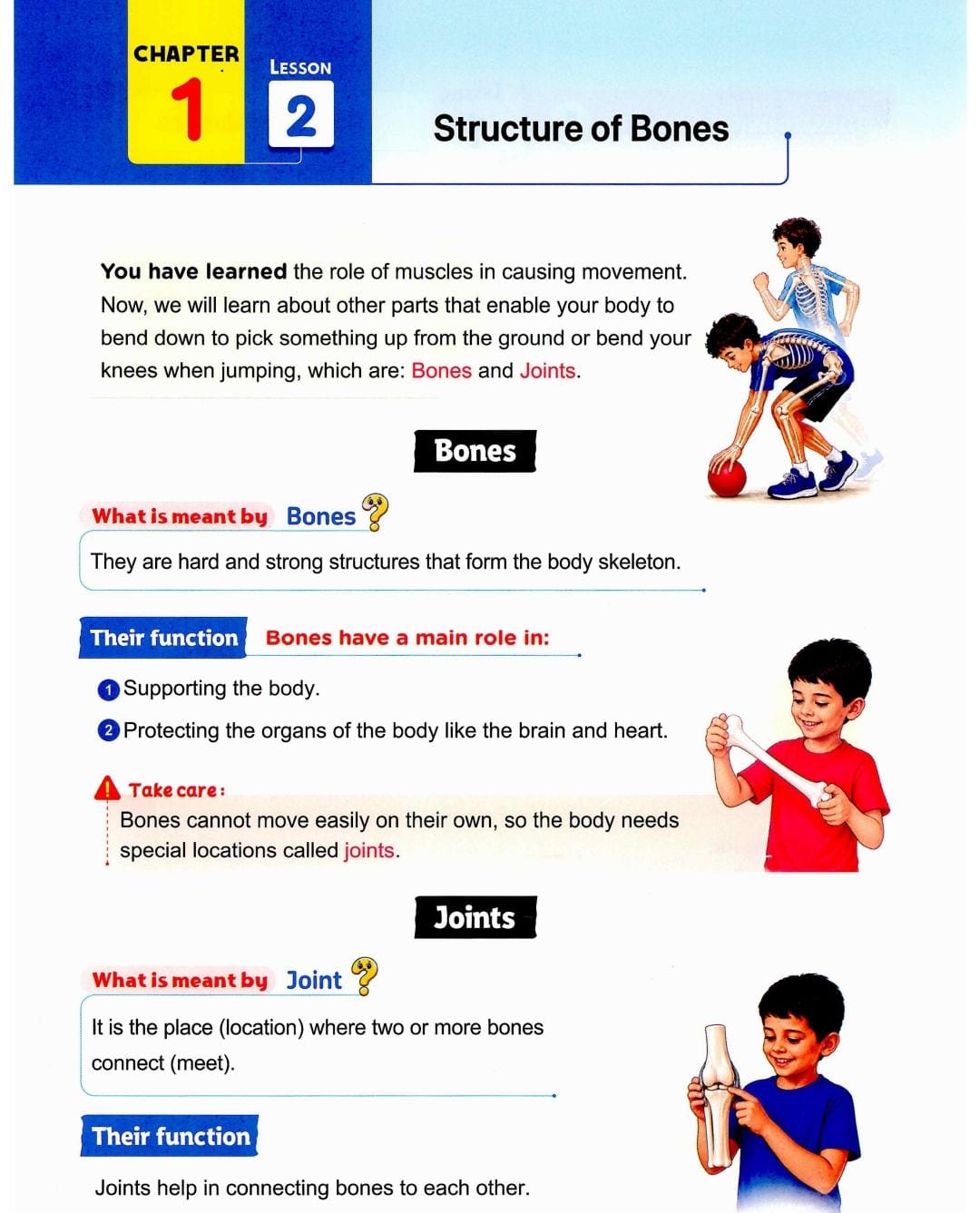
They are hard and strong structures that form the body skeleton.
You have learned the role of muscles in causing movement. Bones and joints let you bend down to pick something up, or bend your knees when jumping.
Their function
- Supporting the body.
- Protecting the organs of the body like the brain and heart.
Take care
Bones cannot move easily on their own, so the body needs special locations called joints.
Drag to rotate · scroll to zoom · right-drag to pan
03 · Discover muscles
Muscles make movement
What is meant by muscles?
They are soft body parts that cause the movement of bones.
Location: Muscles locate under the skin and cover most parts of the body.
Their function
Muscles help the body to move because they pull the bones attached to them, causing body parts to move.
Soft
Under the skin
Cover most of the body
Pull bones
04 · How muscles work
They contract and relax
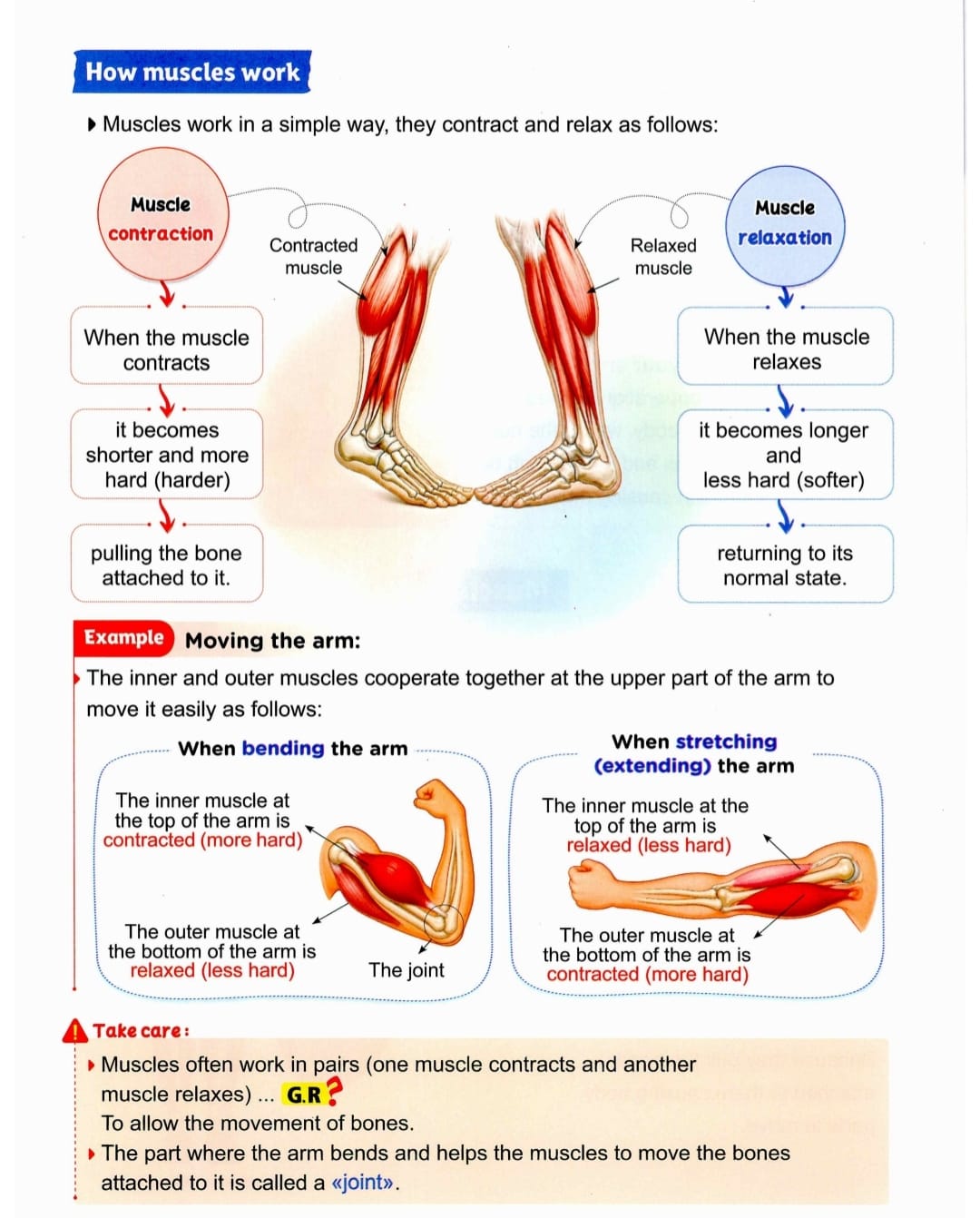
Muscles work in a simple way. They contract and relax as follows.
Muscle contraction
1When the muscle contracts
2it becomes shorter and more hard (harder)
3pulling the bone attached to it.
Muscle relaxation
1When the muscle relaxes
2it becomes longer and less hard (softer)
3returning to its normal state.
05 · Pairs
One shortens, one lengthens
Muscles often work in pairs (one muscle contracts and another muscle relaxes) to allow the movement of bones.
Take care
The part where the arm bends — and helps the muscles to move the bones attached to it — is called a joint.
Contraction
The muscle becomes shorter and harder. It pulls the bone. Movement happens.
Relaxation
The muscle becomes longer and softer. It returns toward its normal state.
06 · How the arm moves
Inner and outer muscles cooperate
The inner and outer muscles cooperate together at the upper part of the arm to move it easily.
When bending the arm
BicepsContracted · shorter & harder
TricepsRelaxed · longer & softer
The joint
The part where the arm bends and helps the muscles to move the bones attached to it is called a joint.
Arm Lab
Watch how muscles help move your bones.
BICEPS · CONTRACTED
TRICEPS · RELAXED
07 · Discover joints
Where bones meet
What is meant by a joint?
It is the place (location) where two or more bones connect (meet).
Their function: Joints help in connecting bones to each other.
Click a real joint on the model. The camera will zoom in and the information panel will explain it.
08 · Types of joints
Two families of movement
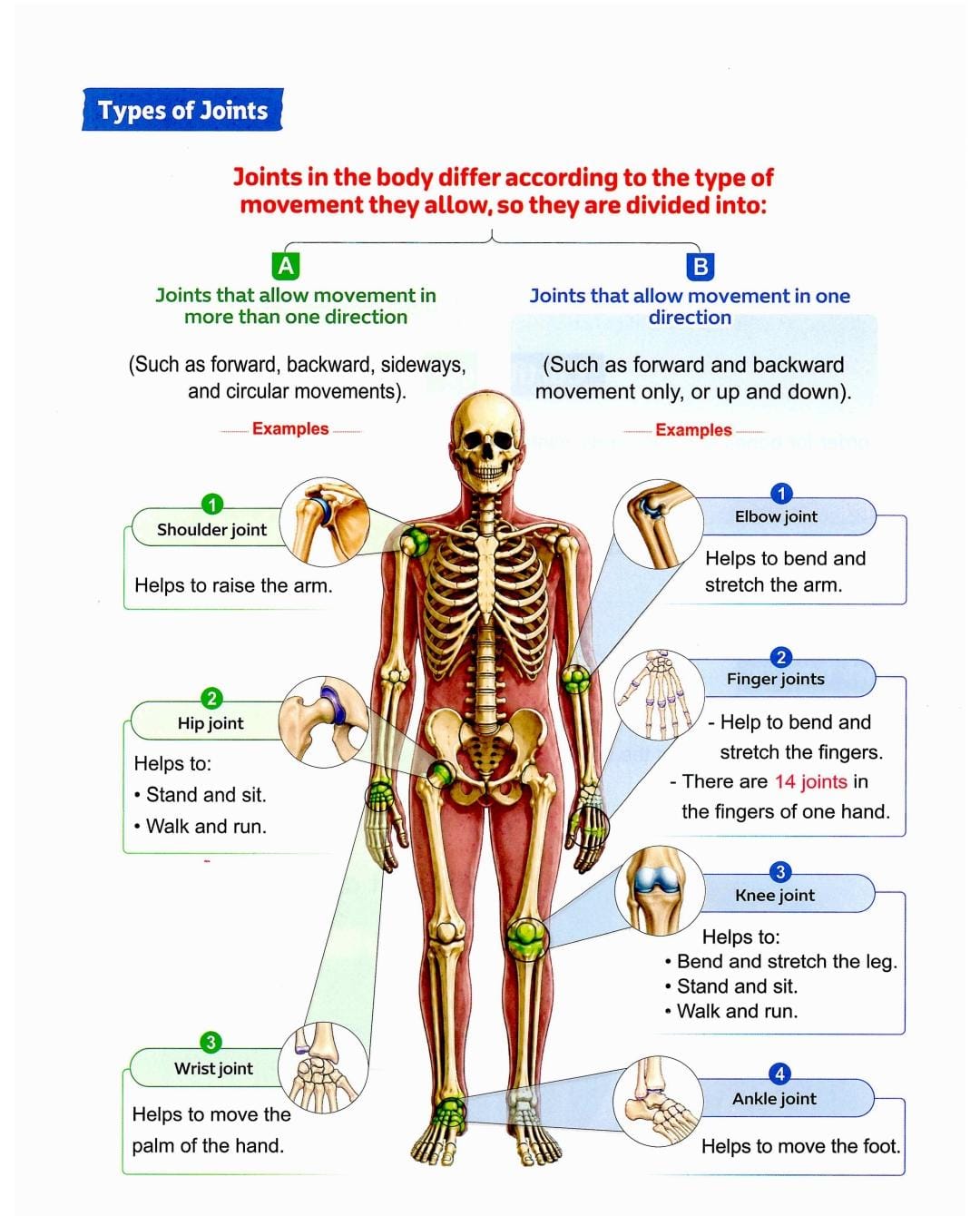
Joints in the body differ according to the type of movement they allow, so they are divided into:
Type A
Movement in more than one direction (forward, backward, sideways, and circular).
Shoulder · Hip · Wrist
Type B
Movement mainly in one direction (forward and backward, or up and down).
Elbow · Finger · Knee · Ankle
09 · Cartilage
A cushion between bones
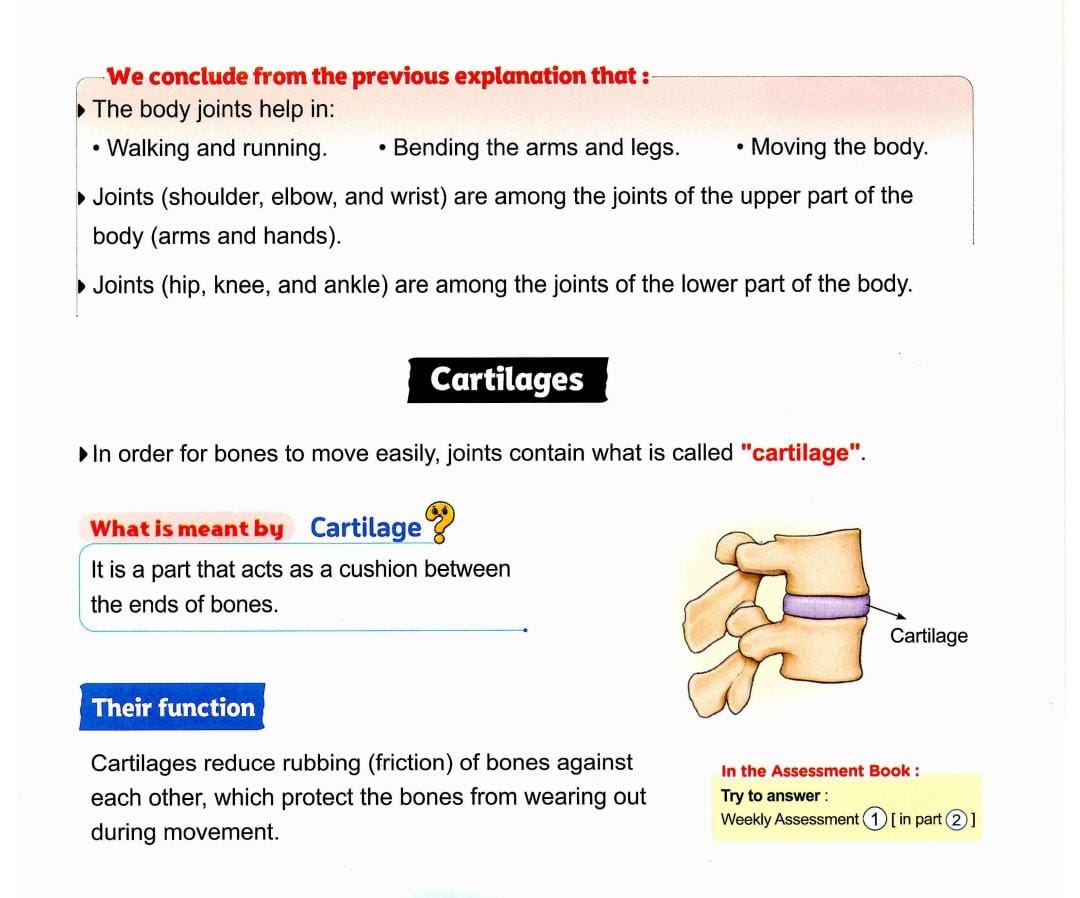
In order for bones to move easily, joints contain what is called cartilage.
What is meant by cartilage?
It is a part that acts as a cushion between the ends of bones.
Their function
Cartilages reduce rubbing (friction) of bones against each other, which protect the bones from wearing out during movement.
Bone
Cartilage
Bone
WITH CARTILAGE · LESS FRICTION
10 · Together
How everything works together
Body joints help in walking and running, bending the arms and legs, and moving the body.
Upper body
Shoulder, elbow, and wrist — joints of the arms and hands.
Lower body
Hip, knee, and ankle — joints of the lower part of the body.
- Muscle
- Contracts
- Pulls bone
- Joint moves
- Body moves
Bones support & protect
Joints connect & bend
Cartilage cushions
Muscles pull the bones.
11 · Interactive challenge
You've explored the human movement system.
Ready to test your knowledge?
Use what you learned about muscles, bones, joints, and cartilage.
12 · Recap
You can explain movement
Muscles
+
Bones
+
Joints
+
Cartilage
=
Movement
Your body is an amazing movement system!
Soft muscles pull hard bones. Joints are where bones meet. Cartilage is the cushion that reduces friction. Together they let you run, jump, and bend.
Muscles pull bones
Bones support & protect
Joints connect & bend
Cartilage cushions
Muscles
Soft body parts that cause the movement of bones. They locate under the skin and cover most of the body.
Contraction
The muscle becomes shorter and harder and pulls the bone attached to it.
Relaxation
The muscle becomes longer and softer and returns to its normal state. Muscles often work in pairs.
Bones
Hard and strong structures that form the skeleton. They support the body and protect organs like the brain and heart.
Joints
The place where two or more bones connect. Type A: more than one direction. Type B: mainly one direction. 14 finger joints in one hand.
Cartilage
A cushion between the ends of bones. It reduces rubbing (friction) and protects bones from wearing out.